You can hide but that thing will get to you Vaccines and opening up in the remote Northern Territory
More trouble at home, says Ray, a young Aboriginal man affiliated with the Judas Priest mob, one of the many gangs from Wadeye named for the metal bands who first captivated the community decades ago on late-night ABC music program Rage.
Ray and a dozen or so extended family, mostly women and children, are taking refuge in Darwin, a six-hour drive from Wadeye on the wretched Port Keats Road, and today they’re in a northern suburbs park with swings for the kids and shade for the sitting.
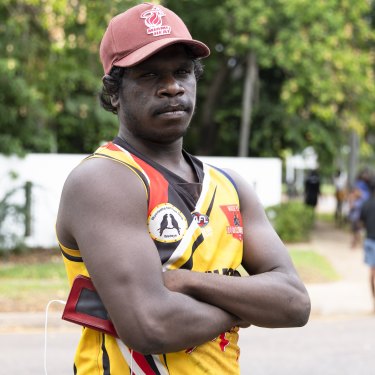
Ray from Wadeye is taking time out in Darwin, maybe until next year. Credit:Krystle Wright
But only Ray and a young woman stick around to answer questions about how this pandemic has affected them. The rest have shot up the road â€" scared, Ray explains later, this approaching white stranger was about to force them to get the needle.
Through broken English, for it is not his first language, Ray explains he’s already twice-dosed with Pfizer, courtesy of a recent stint in jail. The young woman, too shy to say too much, is yet to have her first, even though she is every government’s priority.
Both want to know the same thing: “Where does it come from?â€
The Northern Territory Government will not release the vaccination rates for Wadeye or any remote community, preferring to bundle the numbers into broader regions that incorporate whiter, larger and better-vaccinated towns.
The best the public can know about vaccinations in Wadeye, also called Port Keats, is the first dose rate for the broad “Top End†region (excluding Darwin) is 52 per cent. But even this is fraught. Federal government calculations, which tally the administered shots using Medicare information, put the same region at only 26 per cent for first doses.
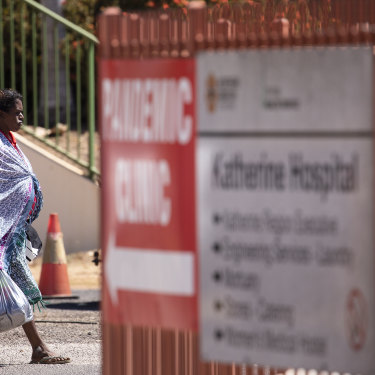
A testing and vaccination clinic in Katherine, about 300 kilometres south of Darwin. Credit:Krystle Wright
The math discrepancy alone could be cause for alarm, given these numbers are supposed to inform such important decisions as “opening upâ€.
And given the Territory has diseases Third World nations have already defeated.
The Doherty Institute modelling â€" taken up by state and territory leaders in their disintegrating compact to transition to living-with-the-virus mode at 70-80 per cent double-dose vaccinations rates of those aged 16-plus â€" does not investigate what opening up means for Australia’s sickest and most health-illiterate populations.
“[One question] is about whether 80 per cent of 16-and-over is appropriate [for opening up], and the answer is ‘no’,†says Dr Jason Agostino of the National Aboriginal Community Controlled Health Organisation.
Like broad geographic groupings can mask vaccination realities within individual communities, so can national or statewide tallies mask low doses in sub-populations, including those living with disabilities, mental health conditions or in very remote locations, Dr Agostino says.
John Paterson, chief executive of the Aboriginal Medical Services Alliance Northern Territory, believes 70-80 per cent may be acceptable in an imaginary homogenous and healthy Australia but “could be devastating for Aboriginal communitiesâ€.
The Doherty Institute is doing work on specific groups of Australians now and will report to an unspecified future meeting of national cabinet.
But the situation in the far-western NSW town of Wilcannia, described by a local health service as an unfolding “humanitarian crisisâ€, is an emerging preview of what can happen when COVID-19 gets into communities whose majority are statistically sick and overcrowded.
Wilcannia is about 60 per cent Aboriginal. Wadeye and most other remote Territory communities are closer to 90 per cent.
As big businesses and federal Treasurer Josh Frydenberg beat the drum for reopening in line with the “very clear [national] planâ€, Mr Paterson warns the conversation is ignoring “extreme and worsening†staff shortages in remote communities; poor access to vaccines compared with large centres; frighteningly high rates of chronic disease in Aboriginal communities; and low vaccine take-up rates.
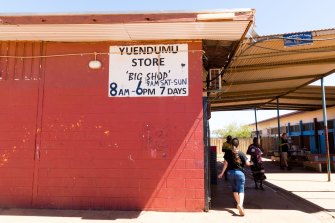
The ‘big shop’ in the remote Aboriginal community of Yuendumu.Credit:Janie Barrett
To protect against needless deaths once Australians are allowed freedoms to move around, public health measures â€" contact tracing, isolation and social distancing â€" need to continue to some extent.
But how to self-isolate if 15 or more other people are living in the same three-bedroom house, Paterson asks.
Consider that a typical remote community â€" and there are more than 70 in the Territory â€" may have only one store from which to buy groceries.
How to feed people if the store became an exposure site, as it presumably would, and needed to close, even for a day?
How to move people and where to put them? The NSW government has started pushing motorhomes into Wilcannia. But what of the many Territory communities such as Wadeye, cut off in the fast-approaching wet season?
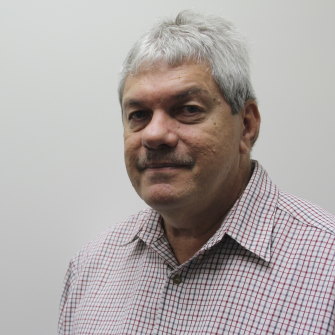
AMSANT chief executive John Paterson.Credit:Dan Harrison
The Territory government would not detail such contingency plans.
Chief Minister Michael Gunner has asked the Doherty Institute to do more “Territory specific†work, particularly taking account its young and vulnerable cohort.
Wadeye has a median age of 25, compared with 38 on Sydney’s North Shore. Even if the community achieved an 80 per cent vaccination rate of over-16s, half of the population would still be without a single dose.
Across the wider Aboriginal population, Dr Agostino says calculating 80 per cent of over-12s still only makes about 60 per cent of the whole.
Mr Paterson says until vaccines are approved for all children, “these 70 -80 per cent targets will be dangerous for our peopleâ€.
Maningrida elder Charlie Gunabarra, also a chairperson for Mala’la Health Services, says his Arnhem Land community is a vaccine success story. While the government will not provide figures, Gunabarra says more than 1300 of the community’s 3500 people got their Pfizer jabs in the first four days of vaccinations alone.
“Some of them run away into the bush, hiding, and I said, ‘you can hide, but that thing will get to you. It’s invisible’. But most of them came,†he says.
Gunabarra has fought vaccine lies carried into the crowded public housing blocks on social media and the lips of misinformed or mischievous visitors.
One rumour was that the vaccine could make you literally explode, Gunabarra says.
“I said, ‘hang on, if you want me to prove it [is safe], I’ll be the first person to get the vaccine’.
“Everyone was watching me. I got that one and everybody was just looking: ‘is he going to fall? Is he going to collapse?’ But then I put my finger up. I said ‘Good’ and everybody got into line.â€
Prime Minister Scott Morrison acknowledged the complexities in remote communities last month when he said some would require a “very bespoke approach†while Australia moved through the phases of reopening.
Bespoke is easier said than done, according to Olga Havnen, the longtime chief executive of Darwin’s Danila Dilba Health Service until July this year.
Havnen says about a third of the Territory’s remote Aboriginal population is on the move at any given time. It could be ceremony. Funerals are far too common. People could be moving to outstations, she says.
Others, such as the fully vaccinated Joyce Lalara from Groote Eylandt, who has Machado-Joseph Disease, have come to Darwin accommodation for an arranged break from community life.
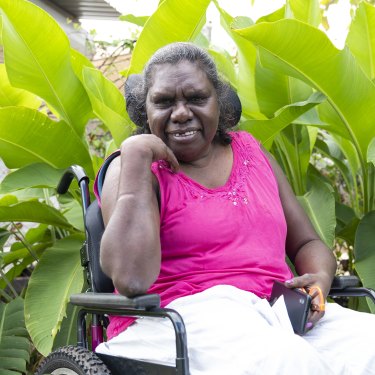
Joyce Lalara from Angurugu on Groote Eylandt: “Some people tell me about that COVID-19. ‘Don’t get the injection because you’ve already got MJD’, they said to me. But I push myself. I have the injection. Both. And I didn’t get sick.â€Credit:Krystle Wright
An infection in Darwin or Alice Springs â€" imported, say, from a vaccinated and healthy Bondi vacationer making good on open borders â€" can spread rapidly no matter the distance to unvaccinated and unhealthy communities.
“The pattern of mobility is not an aberration,†Havnen says. “And it’s something that’s not factored into any kind of planning, as far as I can tell, in terms of government responses. The fact that it has been studiously ignored is unacceptable.â€
Another issue, she says, is that governments have tried to centralise communications instead of letting on-the-ground organisations tailor the right message, from the right people, in the right languages.
“It’s the arrogance of bloody bureaucrats, who know nothing, not wanting to trust us to do a job that we know we can do really well,†she says.
Despite the vaccine turnouts in Maningrida, elder Charlie Gunabarra says too many people will continue to refuse.
“I’m worried. Other mob, too, they’re worried,†he says.
“People have got to be careful who they’re inviting from Darwin, especially long grass (homeless) people.
“And people come from down south, sitting with Aboriginal mob smoking, drinking, ganja â€" whatever - that really worries me. The people sneaking in. I’m sure they’ll be caught, but once it’s spread it’s spread.â€
Zach Hope is a reporter at Brisbane Times. Got a story? Email me at zach.hope@brisbanetimes.com.auConnect via email.
0 Response to "You can hide but that thing will get to you Vaccines and opening up in the remote Northern Territory"
Post a Comment